
SpeciesBaird's rat snake
Baird's rat snake
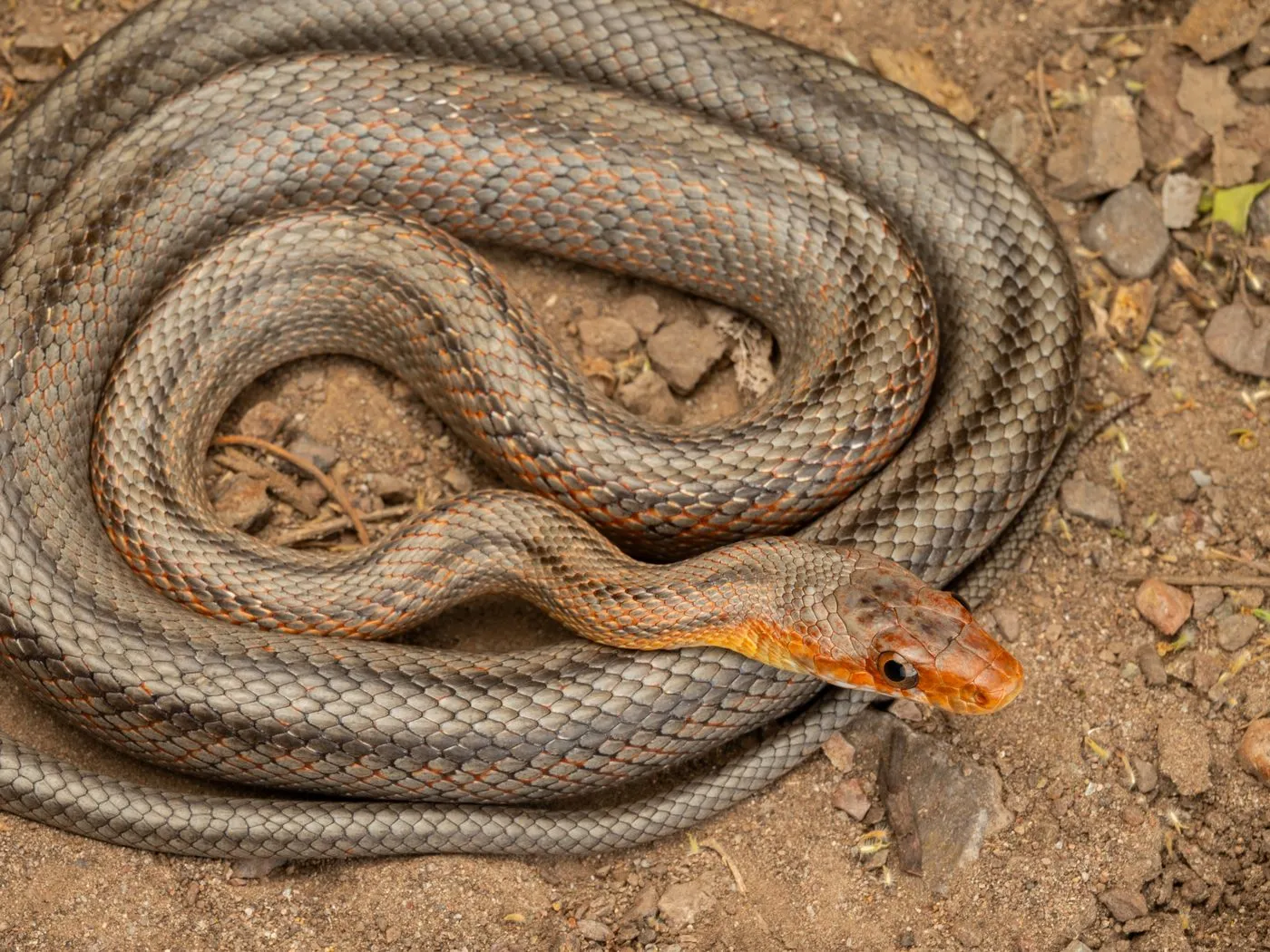
Pantherophis bairdi
A climbing rat snake from the rocky landscapes of Texas and northern Mexico. Its care resembles that of the corn snake. Juveniles are often defensive.
- Group
- Snake
- Origin
- North America
Where the species comes from
- World region
- North America
- Countries
- Southwest and central Texas (USA) as well as Coahuila, Nuevo León and Tamaulipas (Mexico)
- Habitat
- Rocky, wooded slopes and canyons in mountain and plateau country; partly arboreal
The app does not yet hold an origin entry for this species. The distribution given here comes from the specialist literature.
The natural habitat is the yardstick for how you furnish an enclosure. Knowing where an animal comes from is knowing why it needs heat zones, hides and a particular humidity.
Husbandry at a glance
The same details appear in the animal’s profile inside the app.
- Enclosure
- Escape-proof climbing terrarium. The Swiss Animal Protection Ordinance gives no minimum size for this species. The yardstick is the German expert opinion on reptile keeping of 1997: at least 1 × 0.5 × 1 body lengths, so 140 × 70 × 140 cm for a total length of 140 cm. Hobby sources cite 120 × 60 × 60 cm, which is tight for an adult.
- Temperature
- Warm zone about 29–32 °C, cool zone 22–27 °C, basking spot locally up to about 35 °C, at night about 18–25 °C. Sources differ in the details. Control all heat sources with a thermostat.
- Humidity
- Medium, 40–80 % depending on the source. A humid hide helps with shedding. Avoid permanently wet conditions, as they promote respiratory problems.
- Lighting
- About 12–14 hours of daylight. Weak UV-B is possible.
- Substrate
- Diggable, low-dust substrate that is not permanently damp.
- Furnishings
- Climbing branches, rock structures, several hides and a water bowl.
- Water
- Stable bowl with fresh drinking water.
- Feeding
- Thawed mice, rats for large animals. Juveniles about every five to seven days, adults every seven to fourteen days.
- Behaviour
- Climbs well and is mainly crepuscular and nocturnal; sources contradict each other on daytime activity.
- Handling
- Adults are mostly good-natured and easy to handle. Juveniles are nervous and defensive.
- Cohabitation
- Kept singly.
- Health
- Excessive humidity can promote respiratory problems. Monitor weight, shedding and breathing.
- Seasonal cycle
- A winter rest of about two to four months is usual, at 8–12 °C according to the Austrian animal-keeping ordinance and 10–15 °C in hobby sources. Only with healthy animals, fasted beforehand.
- Safety
- Non-venomous, no permit required.
Legal position in Switzerland
No permit foreseen
No permit required. The genus is on the list of harmless venomous snakes in the federal veterinary office’s ordinance on keeping wild animals (SR 455.110.3) and is therefore exempt from the permit requirement under Art. 89 let. h of the Ordinance
No certificate of competence foreseen
No proof of competence required. It is only demanded for the animals named in Art. 89 of the Ordinance
No CITES listing
Not listed in the CITES appendices: Import and transfer require no species-protection papers. Keep the proof of purchase nonetheless
Minimum enclosure dimensions
Annex 2, table 5 of the Animal Welfare Ordinance does not list this species. Among snakes the table names only giant snakes (pythons and boas), elapids, vipers and pit vipers, and a few venomous or dangerous colubrids; for the rest no figure appears there.
The general rule in Annex 2 (letter K) then applies: the enclosure must be large enough for everything the species needs (hides, basking spot, climbing branches) to be arranged sensibly. As a yardstick, the ordinance points to expert opinions on a scientific basis. There is therefore no binding figure. The guide values in the calculator come from the 1997 expert report. Binding information comes from the cantonal veterinary office.
What the enclosure must provide
Escape-proof terrarium, species-specific temperature zones, suitable humidity, hides, water, substrate and, where applicable, a winter rest. Live feeding is permitted only under the strict conditions of Art. 4 para. 3 TSchV.
Paperwork
Keep the purchase contract and proof of origin. Use the scientific name to check CITES and import status reliably.
These details are a guide, not legal advice. Binding information comes from the cantonal veterinary office; the text of the ordinance is what counts. More on the legal position