
Hibernating a tortoise: winter rest in European tortoises
Hibernating a tortoise: which species must hibernate, cold frame, cellar or fridge, temperature, weight checks and waking up. With sources.
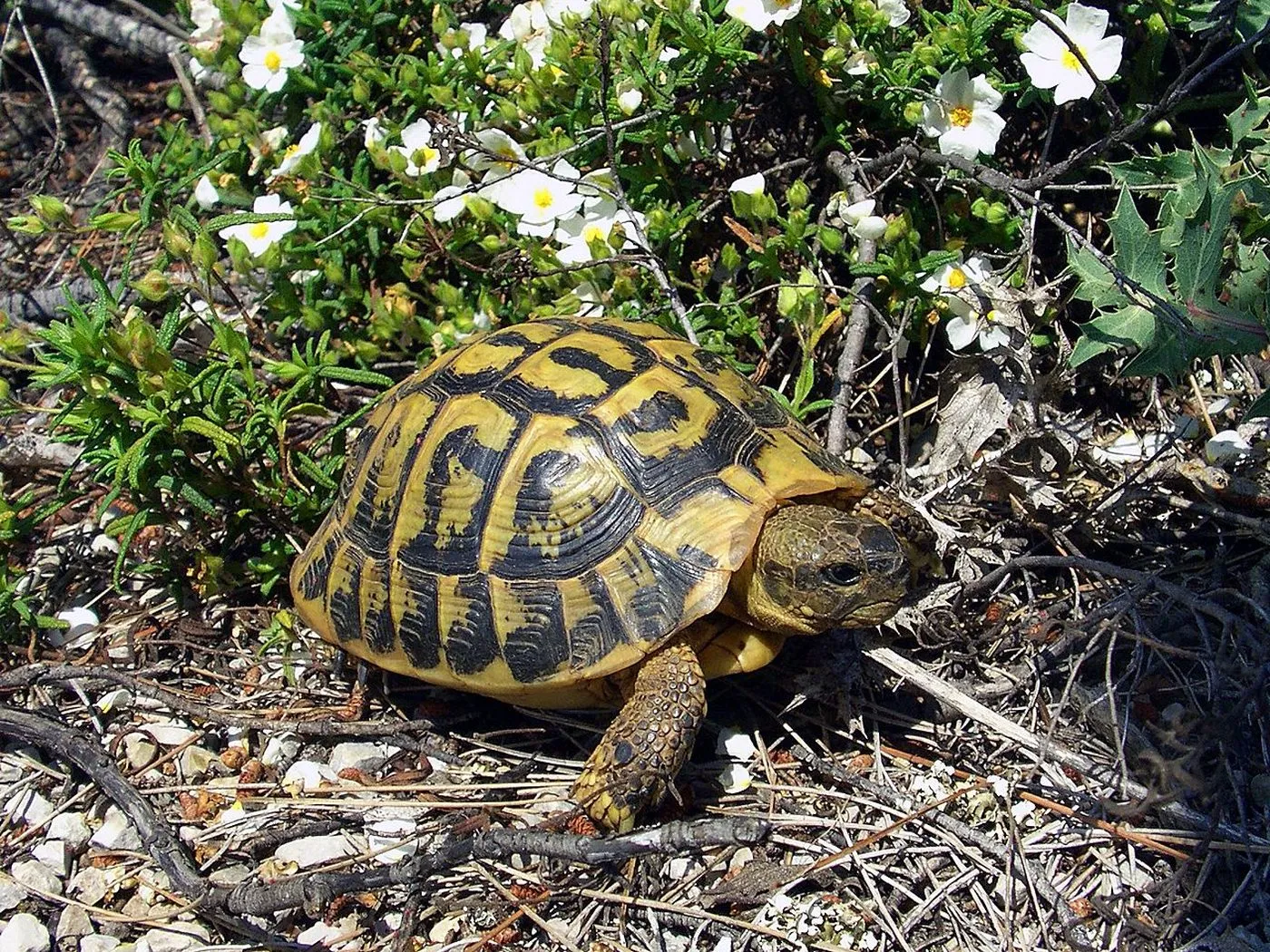
Photo: Orchi, Wikimedia Commons, CC BY-SA 3.0

In short: European tortoises need to hibernate every year, hatchlings included; for the Greek tortoise it depends on its origin. After a health check and fasting they rest three to five months at 4–6 °C, in a cold frame, cool room or fridge. From 5 % weight loss, call the practice; above 10 %, the limit is exceeded.
At the end of October the resting period begins for European tortoises. In the cold frame the first animals are burrowing in, in the vivarium they turn sluggish and barely eat. This article walks through the whole process: preparation, procedure, monitoring, waking up. Where the sources agree there is one figure, where they do not, a range.
Technically, hibernation here is a winter or cold torpor. Tortoises are cold-blooded, their body temperature follows their surroundings, and heartbeat, breathing and metabolism run on a minimum. In everyday speech it is «hibernation» (in the UK often «brumation»); the Swiss ordinance speaks of «winter or cold torpor».
Which species hibernate, and which do not?
Yes: the European tortoises. These include Hermann’s tortoise (Testudo hermanni), the Greek tortoise (T. graeca), the marginated tortoise (T. marginata) and Horsfield’s tortoise (T. horsfieldii). According to the Swiss tortoise interest group SIGS (Schildkröten-Interessengemeinschaft Schweiz), the Mediterranean species hibernate in the wild, hatchlings already in their first winter. The Thieme pet-owner information says the same of European tortoises of every age. The German Federal Chamber of Veterinarians (Bundestierärztekammer, BTK) calls the annual rest extremely important for health: hormone balance and immune system depend on it, and without the pause young animals grow too fast.
With a reservation: the Greek tortoise (T. graeca). Testudo graeca covers several forms. Animals of European origin rest for several months. According to SIGS, North African animals are active in winter and rest in the hot summer, and the Austrian animal husbandry ordinance lists T. g. graeca without hibernation in the usual sense. The Gerlitzki veterinary practice advises against hibernating southern Spanish and Moroccan animals by the usual scheme. So establish the origin from the papers and, if in doubt, ask the vet.
No: tropical and subtropical tortoises. African spurred tortoises stay active all year (WEB.DE). For the red-footed tortoise, the Austrian ordinance gives as a guide for outdoor keeping that the temperature should not stay below 20 °C for long, and it lists no hibernation. Both species are kept warm. Cooling down to 4–6 °C does not suit them.
What Swiss law says
The Animal Protection Ordinance (TSchV, SR 455.1) covers this in Annex 2, Table 5 (reptiles). Row 4 concerns the «European tortoises (Testudo graeca, T. hermanni, T. marginata, T. horsfieldii)» and refers, among other things, to note 4 (own translation; the German, French and Italian versions are authoritative):
«The climatic conditions throughout the year must be chosen so that a winter or cold torpor or a dry-season rest can take place for all age classes.»
Housing must therefore make hibernation possible, expressly for young animals too. The ordinance gives no figures for temperature or duration; it refers to the terrarium literature and the technical information of the FSVO (preliminary remark B). For hibernation, animals may be kept temporarily in smaller enclosures (preliminary remark D). For the tropical tortoises (rows 2 and 3), note 4 is absent. The version checked is that of 1 February 2026.
The FSVO (BLV) writes on its page about European tortoises: they must live in an outdoor enclosure day and night, a cold frame is indispensable as a dry retreat, and the animals can hibernate in it if they can dig deep enough into a suitable substrate. The FSVO gives no temperatures there.
Preparation: late summer to autumn
Health check with a faecal sample. Before hibernation the animal should see a reptile vet (find practices here). The vet checks the general condition and examines the faeces for parasites (BTK). The timing is early: Synlab names the end of August, AniCura offers the check in August and early September. SIGS explains why: a dewormer only works with an active metabolism, and the animal must then stay active for a good while. So deworming is best done in summer, in August at the latest (the Italian-language SIGS page says end of July). Anyone who has not had a check by the end of October should call the practice before the animal goes into hibernation.
Do not hibernate. Sick, injured or underweight animals spend the winter in the vivarium (SIGS, Dr Friedrich). For sexually mature females, Dr Friedrich recommends checking for unlaid eggs, with an X-ray if necessary.
Note the starting weight. Weigh the animal before hibernation (Synlab, TVT, Thieme). The value is the reference for all later checks.
Fasting. In an outdoor enclosure the animals stop eating on their own in autumn, and the gut empties as the amount of food falls (SIGS). In the vivarium, light and temperature are lowered step by step over two to three weeks (Synlab and Dr Friedrich two, BTK three weeks). Feeding ends one to three weeks before hibernation (Dr Friedrich one week, TVT two, BTK at the start of the reduction). Drinking water is always available.
A bath before the rest? The sources contradict each other. BTK considers lukewarm baths advisable, Dr Friedrich one or two a week but not excessive. SIGS calls forced baths stress, and Synlab writes «Do not bathe»: a completely empty gut would kill the gut flora. Thieme and BTK agree that the animal should be able to drink before the rest.
Do not cool down uncontrolled. A Royal Veterinary College survey (252 questionnaires, 270 Testudo in the United Kingdom) found hibernation in a garden and an uncontrolled drop in temperature before the rest to be the main risk factors for illness and death. Mortality was 7.8 %. SIGS also warns against bringing an animal into a warm, bright room in the middle of preparation: it would fall into a drowsy state.
Procedure: methods, temperature, substrate
| Method | How the sources rate it | Key points |
|---|---|---|
| Cold frame or greenhouse with a pit | SIGS: first choice. FSVO: possible if the animals can dig deep enough | Pit at least 50 cm deep, mouse-proof, with drainage (SIGS) |
| Cool room, cellar, light well | SIGS: recommended. BTK: problematic, the temperature fluctuates | 2 to 6 °C, dark, quiet, mouse-proof (SIGS) |
| Separate refrigerator | BTK: best and safest method. SIGS: only a stopgap. Thieme: risk of drying out and freezing | 4 to 6 °C, ventilate briefly every week (SIGS, BTK) |
| Outdoors without protection | SIGS: very risky. RVC survey: garden as a risk factor | not recommended |
Which method suits depends on garden, cellar and experience. Discuss it with the vet. In every case what counts is a constant, monitored temperature.
Temperature. The most frequently cited target is 4 to 6 °C (BTK, Synlab, Thieme, Austrian ordinance, SIGS for the refrigerator). Other figures are 2 to 6 °C (SIGS for rooms, TVT 2017), 4 to 8 °C (Dr Friedrich, Austrian ordinance for Horsfield’s tortoise) and 4 to 10 °C (TVT 2004). At the bottom the limit is frost. At the top Dr Friedrich warns: above 10 °C the metabolism starts up but the animals do not eat, risking liver damage or starvation. Check the temperature at least weekly (Dr Friedrich). A thermometer with a min-max memory is handy: it shows whether the temperature slipped out of range in between. In the refrigerator the probe goes next to the box, because the gradient can be large and frost threatens near the cooling coils (SIGS).
Container and substrate. The animal must be able to bury itself completely. BTK gives about four times the shell area, SIGS 60 × 40 cm proven in practice. Loose garden soil with bark mulch is preferred, covered with damp beech leaves (SIGS, BTK). According to SIGS, other leaf types (mould, tannic acid), hay (mould) and dusty substrates are unsuitable. The box is ventilated (otherwise mould, BTK) and secured against mice, rats and martens.
Moisture. In the box the substrate is slightly damp, not wet (BTK, Dr Friedrich). For the pit in a cold frame, SIGS asks for a distinctly damp, almost wet substrate. Figures for air humidity diverge: Synlab gives 70 to 80 %, Dr Friedrich 40 to 60 %. According to SIGS, substrate that is too dry is the cause of weight loss, because that loss is water loss.
Duration.
| Group | Duration | Source |
|---|---|---|
| Hermann’s, Greek (European origin), marginated tortoise | 3 to 5 months at 4–6 °C, often about 4 months in practice | Austrian ordinance, Thieme, BTK, Synlab |
| Horsfield’s tortoise | 3 to 5 months at 4–8 °C | Austrian ordinance |
| Lower limit | at least 8 weeks | Dr Friedrich |
| Young animals in the first year | 6 to 8 weeks (BTK), 2 to 4 months (Gerlitzki), as long as adults (SIGS) | BTK, Gerlitzki, SIGS |
In the wild, hibernation lasts about five months on average, from mid-October to mid-March, shorter the further south (SIGS). In a cold frame the animals decide start and end themselves.
Young animals. Hatchlings hibernate too, in the wording of the TSchV «for all age classes». Keeping them warm in an indoor vivarium leads, according to SIGS, to developmental defects, according to BTK to growth that is too fast. How long the rest may be in the first year is judged differently by the sources (see table). Have the duration for your animal confirmed by a vet.
Monitoring during hibernation
Principle: disturb as little as possible. According to Thieme, the animal must not be woken during the rest. In a cold frame, monitoring is, according to SIGS, hardly possible and not necessary anyway. With a box, cellar or refrigerator you check temperature, substrate moisture and weight.
Weighing. Intervals differ: every 14 days (BTK 2012), every three to four weeks (BTK 2013, Gerlitzki), about monthly (Synlab, Dr Friedrich, who also names weekly in the same text). The reference is the weight at the start of the rest (Synlab). SIGS regards such checks as a disturbance and as disputed. With a box, the substrate must be checked at least every 14 days and, if necessary, briefly sprayed.
What loss is normal? This is where the sources differ most.
- Up to 10 % of the starting weight: BTK, Synlab, Dr Friedrich, Gerlitzki, SIGS (Italian-language page).
- At most 5 %: TVT (2004 and 2017).
- As a guide for a normal course, Texas A&M University gives about 1 % per month (for turtles and tortoises in general).
For an 800 g animal, 5 % is therefore 40 g and 10 % is 80 g. In practice: from 5 % a call to the practice is worthwhile, above 10 % the limit is exceeded in all the sources cited. A marked loss is never the aim of the rest, but a sign of water loss (SIGS) or illness.
Warning signs. Call the vet and end the rest in agreement with them, slowly over a few days, if you see:
- weight loss beyond the limit (Synlab, Dr Friedrich),
- discharge from the eyes or nose, swollen eyes, coatings in the mouth (Synlab, Gerlitzki),
- red patches or bleeding in the shell, especially the plastron (BTK 2013: see a vet at once; Synlab; Gerlitzki),
- persistent restlessness (Synlab, Gerlitzki),
- mould on the substrate or the animal, wet or rotting areas of shell (Gerlitzki).
Passing urine. Practical guides also name passing urine during the rest as a reason to warm the animal up carefully and have it examined (WEB.DE). That is plausible, because water loss is the central danger of the rest, but it is not backed by a veterinary source. If in doubt, the advice of the Gerlitzki practice applies: better to call once too often than once too rarely.
Waking up
Naturally in the cold frame. In spring the layer of leaves or straw is removed, the soil warms up and the animals wake on their own. A heat lamp helps on cool days (SIGS).
Box, cellar, refrigerator. The temperature rises slowly over a few days (BTK 2013), the Gerlitzki practice gives five to eight days. Light and day length are also increased slowly (Synlab). Offer a water dish: drinking matters more than eating (Synlab), warm baths revive the animal’s spirits (BTK).
Light and UV. After waking, the animal needs warmth and UV-B. The FSVO mentions, for cool, rainy spring and autumn days, a substitute source such as a heat lamp. UV-B is needed because vitamin D3 forms only through it and is required to store calcium.
When must it eat? If the animal is warm and active, it usually starts eating again after a few days, with droppings only after two to three weeks (Gerlitzki). Hibernation counts as finished when the animal is active and eating (Synlab).
When to the vet? The time right after the rest is critical: undetected illnesses and mistakes show up now (Synlab). Reasons for an examination are no intake of food and above all of water, apathy and no urine. A blood test of liver and kidney function is then sensible. If a warm animal touches no food after about a week, the vet should take a look (WEB.DE). The Italian-language SIGS page sets a stricter limit of two days.
Common mistakes
| Mistake | Consequence | Better |
|---|---|---|
| Hibernation denied, young animals in an indoor vivarium | Developmental defects, growth too fast (SIGS, BTK) | Hibernate young animals cool too |
| No health check, deworming too late | Parasites, drug not cleared (SIGS, Synlab) | Faecal sample and check in August or September |
| Hibernating a sick or underweight animal | Deterioration during torpor (SIGS, Dr Friedrich) | Winter in the vivarium, under veterinary care |
| Temperature lowered uncontrolled or fluctuating | Main risk in the RVC survey; metabolism starts up | Lower step by step, thermometer with min-max |
| Substrate too dry | Water and weight loss (SIGS) | Check every 14 days, keep slightly damp |
| Wrong substrate (hay, other leaves, dust) | Mould, tannic acid, breathing problems (SIGS) | Soil, bark mulch, beech leaves |
| Burrowing unprotected in the garden | Frost, mice, rats (SIGS, Dr Friedrich) | Cold frame with a mouse-proof pit |
| Bringing the animal into the warm before hibernation | Dangerous drowsiness (SIGS) | Let the preparation run undisturbed |
| Checking or waking too often | Disturbance of the rest (SIGS, Thieme) | Check only to a fixed plan |
How ReptiCare helps
- Starting weight and checks: enter the weighing before hibernation and set the checks up as a recurring appointment: every 14 days, monthly or at your own interval in days. The curve shows the change in absolute terms and as a percentage. The app’s prompt compares with the peak of the last 90 days. That is a rule of thumb, not a veterinary limit; the 5 or 10 % mark you keep an eye on yourself. More: Recording weight.
- Plan the hibernation (Pro): start and end as a period of its own, with a reminder (called «Brumation» in the app). During hibernation and for three weeks afterwards, the long-feeding-pause warning does not appear. See Care and health.
- Dossier for the vet practice (Pro): PDF dossier or CSV export of the curves, to take along before or after the rest.
Curve, appointments and prompts are free (up to two animals). Hibernation plan, dossier and CSV are part of Pro, a one-off CHF 10, no subscription.
This article is general information and does not replace veterinary advice. In case of illness, young animals or unclear origin, the reptile vet decides.
Sources
- SR 455.1 Animal Protection Ordinance (TSchV), Annex 2, Table 5 and preliminary remarks (de/fr/it only): Fedlex
- FSVO (BLV), in German: Europäische Landschildkröten
- SIGS (de): Überwinterung von mediterranen Landschildkröten and Aufzucht; Italian-language version: Il letargo delle tartarughe terrestri europee
- Bundestierärztekammer, press releases (de) 33/2012 and 20/2013
- TVT leaflets (de): European tortoises (2004) and Hermann’s tortoise (2017)
- Synlab (de): Leaflet on carrying out hibernation
- Thieme (de): Heimtier-Info Landschildkröte
- AniCura (de): Winterstarre bei europäischen Landschildkröten
- Dr Friedrich, after «kleintier konkret» (de): Einwinterung
- Gerlitzki practice (de): Winterruhe bei Schildkröten (keepers’ advice, published by the practice)
- Republic of Austria, 2. Tierhaltungsverordnung, Annex 3 (reptiles) (de)
- Baldrey, Guezennec, Hedley (2022): Risk factors influencing brumation success in captive tortoises in the United Kingdom. Vet Rec 190(8):e1377. doi:10.1002/vetr.1377
- Texas A&M University: Turtle Brumation
- WEB.DE (de): Schildkröte überwintern
Common questions
- Which tortoises need to hibernate?
- The European tortoises: Hermann’s, marginated and Horsfield’s tortoises, plus Greek tortoises of European origin, hatchlings included. North African Greek tortoises are active in winter and rest in summer. Tropical species such as the African spurred tortoise and the red-footed tortoise do not hibernate.
- At what temperature does a tortoise hibernate?
- The most commonly cited value is 4 to 6 °C, constant and frost-free. Some sources give 2 to 6 °C or 4 to 8 °C. Above 10 °C the metabolism starts up without the animal eating.
- Fridge, cellar or cold frame: which method?
- SIGS calls the cold frame with a pit the first choice and the fridge only a stopgap. The BTK considers a separate fridge the safest method because the temperature stays constant. Choose the method together with your vet.
- How much weight can a tortoise lose during hibernation?
- Most sources give at most 10 % of the starting weight, the TVT leaflet at most 5 %. From 5 % a call to the practice is worthwhile; above 10 % the limit is exceeded in all sources.
- How long does hibernation last?
- For Hermann’s, marginated and Greek tortoises of European origin three to five months, in practice often around four. For hatchlings in their first year, the figures range from six to eight weeks to the full duration.