
SpeciesGila monster
Gila monster
Heloderma suspectum
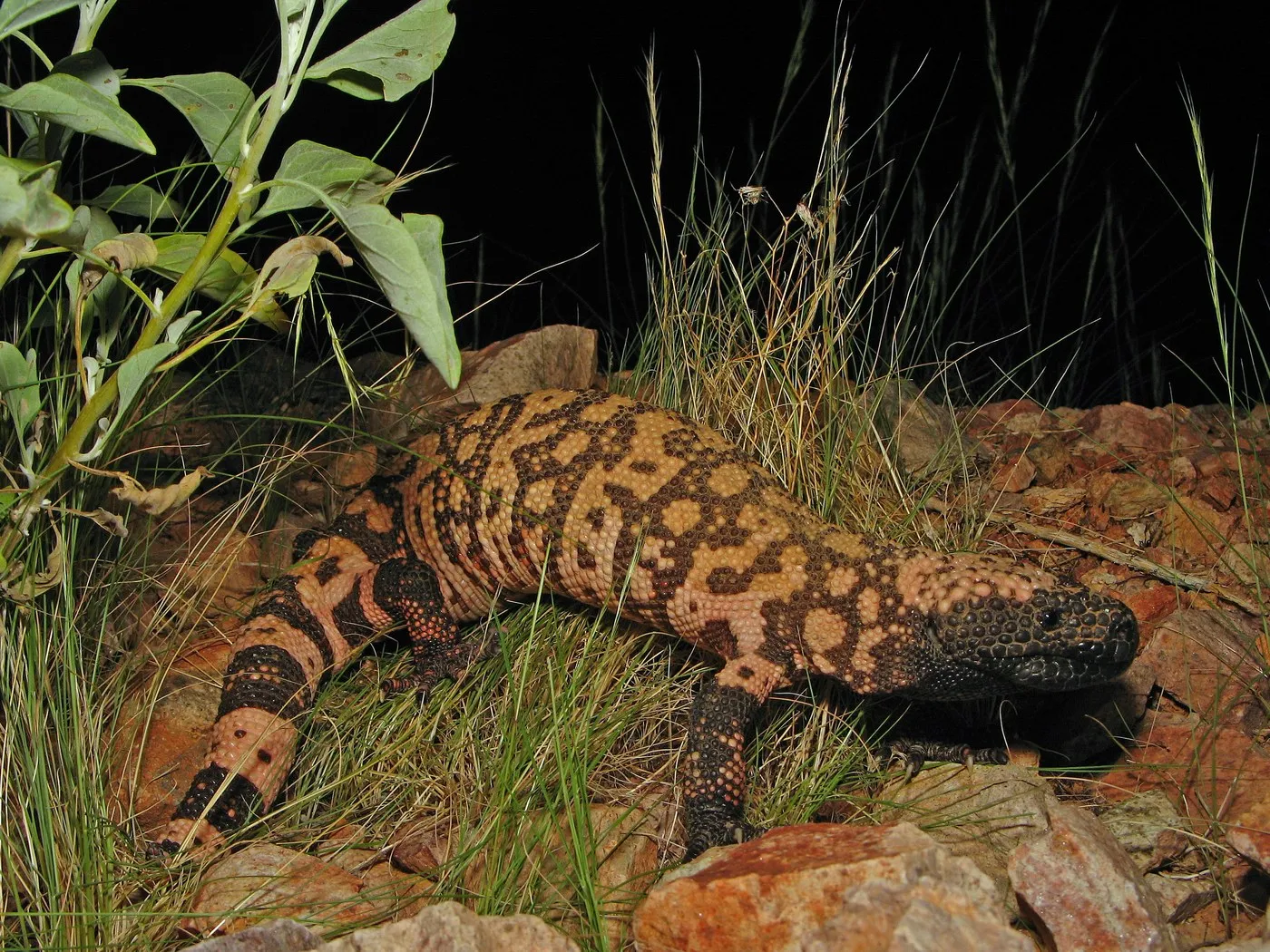
One of the few venomous lizards in the world: Slow and mostly calm, and for that very reason often underestimated. A bite is a medical emergency. Requires a permit in Switzerland.
- Group
- Lizard
- Level
- Advanced
- Origin
- North America
Where the species comes from
- World region
- North America
- Countries
- South-western USA (Arizona, New Mexico, southern Nevada, south-western Utah, south-eastern California) and north-western Mexico (Sonora, Sinaloa)
- Habitat
- Cactus desert, scrubland and oak woodland, preferably where the microclimate is more humid; about 90 % of the time in burrows and under rocks
The app does not yet hold an origin entry for this species. The distribution given here comes from the specialist literature.
The natural habitat is the yardstick for how you furnish an enclosure. Knowing where an animal comes from is knowing why it needs heat zones, hides and a particular humidity.
Husbandry at a glance
The same details appear in the animal’s profile inside the app.
- Enclosure
- Ground dweller: A large floor area for a clear temperature gradient; height is secondary. Lockable and escape-proof: These animals even climb rough walls.
- Temperature
- A gradient from 22 to 32 °C, plus a basking spot of about 35 °C.
- Humidity
- Generally dry, but a hide with moist substrate is essential.
- Lighting
- UVB and a bright heat lamp above the basking spot. Under the Animal Welfare Ordinance, floor heating or infrared alone are not enough.
- Substrate
- About 10 cm of sand for rooting and digging, kept moist in one spot. Paper or bark chips are unsuitable.
- Furnishings
- Large hides, stable rock structures and rough sandstone to wear down the claws. Fix everything firmly: Gila monsters dig over their terrarium for hours.
- Water
- A shallow, tip-proof water dish, refilled with fresh water regularly.
- Feeding
- Mice, small rats, day-old chicks and quail eggs. Adults eat rarely but a lot at once and store fat reserves in the tail; young animals about once a week. Offer food only with long tongs and gloves.
- Behaviour
- Spends most of its life in hiding. Slow but with stamina, with a very keen sense of smell; climbs well.
- Handling
- Do not handle. Where unavoidable, only with thick, lined leather gloves. The calm behaviour is deceptive: Most bites hit keepers’ fingers and hands.
- Cohabitation
- Singly or one male with one or more females. Males fight each other during the breeding season.
- Health
- Robust when kept correctly; individual animals have been kept for over 35 years. Check weight and tail thickness regularly: The tail is the fat store.
- Seasonal cycle
- Winter rest from about November to March at around 13 °C. For breeding it needs at least three months. Young animals do not hibernate in their first year.
- Safety
- Venomous. A bite is very painful and a medical emergency: Detach the animal at once, remove jewellery, immobilise the bitten body part, go to hospital straight away and call Tox Info Suisse (phone 145). Do not suck out, do not cut, do not apply a tourniquet. For healthy adults a bite is usually not fatal; in 2024, however, a keeper in the USA died after being bitten by his animal. Requires a permit under Art. 89 of the Ordinance; the terrarium needs safety locks.
Legal position in Switzerland
Permit required
Requires a permit. Art. 89 let. f of the Ordinance expressly names the beaded lizards and Gila monsters (Heloderma), and Annex 2, Table 5 lists the Gila monster under item 35a with the note that private keeping requires a permit. The cantonal veterinary office issues the permit before acquisition
Training required
Proof of competence under Art. 85 para. 3 let. c of the Ordinance is required. It is a precondition for the permit and must be obtained before acquisition
Species protection applies
CITES Appendix II: Import and transfer only with papers. When buying, ask for proof of origin and captive breeding
Minimum enclosure dimensions
Annex 2, table 5 of the Animal Welfare Ordinance does not prescribe centimetres but multiples of body length. For this species, item 35a (Gila monster): floor area 4 × 3 body lengths, height 2 body lengths. The floor area applies to at most two animals; each further animal requires an additional 2 × 2 body lengths.
For this group, body length means the snout-vent length, without the tail. The largest animal in the enclosure is what counts. The enclosure may not be smaller even if fewer animals live in it than the table names.
| Snout-vent length | At least |
|---|---|
| 25 cm | 100 × 75 × 50 cm |
| 30 cm | 120 × 90 × 60 cm |
| 35 cm | 140 × 105 × 70 cm |
Animals may temporarily be kept in smaller enclosures: for quarantine, for the treatment of illness and injury, for acclimatisation, for breeding and rearing, and for winter or cold dormancy or aestivation (preliminary remark D on reptiles).
This is the legal lower limit, not a recommendation. An enclosure that meets exactly these dimensions is permitted, but not good for that reason. The details under “Husbandry at a glance” describe how the enclosure should be furnished, not how small it may be.
What the enclosure must provide
For venomous reptiles such as Gila monsters, Annex 2 of the Ordinance requires an enclosure that takes sufficient account of safety, with safety locks such as padlocks or bolts (preliminary remark C on Table 5). For item 35a it also requires: A temperature suited to the animals’ needs with a heat source, ground that can partly be dug in, hides, a solid enclosure construction and bright lamps (HQL, HQI or comparable) for the basking spot. The social structure must be respected. The veterinary office will tell you before acquisition whether the canton imposes further conditions.
Paperwork
Keep the keeping permit, certificate of competence, purchase contract and an unbroken proof of origin. For CITES-protected species, the required CITES documents and species protection checks apply to every border crossing.
These details are a guide, not legal advice. Binding information comes from the cantonal veterinary office; the text of the ordinance is what counts. More on the legal position