
SpeciesMangrove snake
Mangrove snake
Boiga dendrophila
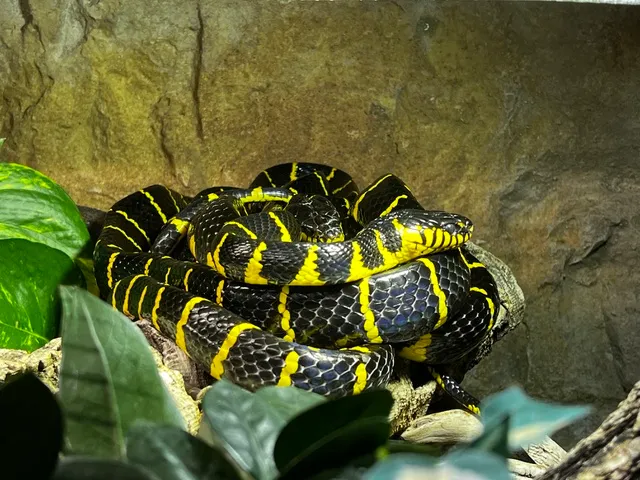
A powerful, strictly nocturnal rear-fanged snake from Southeast Asia, black with yellow or white bands, that hunts in trees, on the ground and in water. A permit is required in Switzerland: in extreme cases its venom can cause severe symptoms, and there is no antivenom.
 Roger AeberhardExpert article and photo · Venomous snake specialist
- Group
- Snake
- Origin
- Southeast Asia
Where the species comes from
- World region
- Southeast Asia
- Countries
- Indonesia, Malaysia, Brunei, Thailand, Cambodia, Myanmar, Vietnam and the Philippines; the subspecies B. d. dendrophila only on Java
- Habitat
- Lowland rainforests, mangrove swamps and dense waterside vegetation, warm and humid all year: in trees, on the ground and in water, where it hunts; by day in tree forks, tree hollows or under bark and stumps
The app does not yet hold an origin entry for this species. The distribution given here comes from the specialist literature.
The natural habitat is the yardstick for how you furnish an enclosure. Knowing where an animal comes from is knowing why it needs heat zones, hides and a particular humidity.
Husbandry at a glance
The same details appear in the animal’s profile inside the app.
- Enclosure
- A tall, secured enclosure with a safety closure, set up like a densely wooded mangrove jungle.
- Temperature
- In summer up to 32 °C by day under the heat spot, around 24 °C at night; in winter 26–28 °C by day, 18–20 °C at night. The highest values only in one spot, not throughout the enclosure.
- Humidity
- About 50 % thanks to the water basin; mist with barely lukewarm water once or twice a week, and additionally before and during shedding. 70–80 % in the hide box with soil and moss.
- Lighting
- A heat spot up high.
- Substrate
- Peat substitute or plain, unfertilised soil.
- Furnishings
- Plenty of branches and cork bark up high for climbing and resting, plus a hide box on the ground that is readily used by day.
- Water
- A larger water basin.
- Feeding
- Spread dead mice or rats in the enclosure, two to three per animal depending on size; they only eat after nightfall and not while shedding. At first young snakes often accept only live hairless mice; live prey is allowed only under the conditions of Art. 4 para. 3 of the Ordinance, for example if dead prey is not accepted.
- Behaviour
- Strictly nocturnal; sleeps by day up high or in the hide box.
- Handling
- With two hooks: the animals stay draped on the hooks well. With large animals, mind their reach; they open their mouths almost 180°.
- Cohabitation
- Strictly alone until five years old. After that, yellow-banded animals in pairs if they are about the same size; white-banded ones are more prone to cannibalism.
- Health
- Carry out checks without contact wherever possible; use a reptile vet experienced with venomous snakes.
- Seasonal cycle
- In winter 26–28 °C by day and 18–20 °C at night. Up to five clutches a year, usually three to four of three to ten eggs; incubation at 26–29 °C and up to 100 % humidity for 103 to 120 days, without water drops on the eggs.
- Safety
- Venomous: a rear-fanged snake with grooved fangs at the back of the mouth. In extreme cases swelling, necrosis and neurological symptoms up to respiratory arrest; there is no antivenom. Permit, expertise and an emergency plan are mandatory.
In more detail in the expert article by Roger Aeberhard: «The mangrove snake: notes from practice» (in German)
Legal position in Switzerland
Permit required
Requires a permit as a venomous snake under Art. 89 let. h of the Ordinance: it covers snakes that have a venom apparatus and can use it. Only species designated harmless by the federal office are exempt; the mangrove snake is not among them. Permit and proof of competence are required before acquisition
Training required
Proof of competence under Art. 85 para. 3 let. c of the Ordinance is required. It is a precondition for the permit and must be obtained before acquisition
No CITES listing
Not listed in the CITES appendices: Import and transfer require no species-protection papers. Keep the proof of purchase nonetheless
Minimum enclosure dimensions
Annex 2, table 5 of the Animal Welfare Ordinance does not prescribe centimetres but multiples of body length. For this species, item 46 (Dangerous rear-fanged snakes): floor area 1 × 0.5 body lengths, height 0.7 body lengths. The floor area applies to at most two animals; each further animal requires an additional 0.5 × 0.2 body lengths.
For this group, body length means the total length, from snout to tail tip. The largest animal in the enclosure is what counts. The enclosure may not be smaller even if fewer animals live in it than the table names.
| Total length | At least |
|---|---|
| 150 cm | 150 × 75 × 105 cm |
| 180 cm | 180 × 90 × 126 cm |
| 200 cm | 200 × 100 × 140 cm |
| 220 cm | 220 × 110 × 154 cm |
| 250 cm | 250 × 125 × 175 cm |
Animals may temporarily be kept in smaller enclosures: for quarantine, for the treatment of illness and injury, for acclimatisation, for breeding and rearing, and for winter or cold dormancy or aestivation (preliminary remark D on reptiles).
This is the legal lower limit, not a recommendation. An enclosure that meets exactly these dimensions is permitted, but not good for that reason. The details under “Husbandry at a glance” describe how the enclosure should be furnished, not how small it may be.
What the enclosure must provide
Contact the cantonal veterinary office before acquiring the animal. This is mandatory. An escape-proof enclosure with a safety closure (a bolt is sufficient), safe working procedures and, depending on the canton, further safety conditions are required. A permit is granted only if the enclosure, equipment, expertise and protection of people and animals are adequate.
Paperwork
Keep the keeping permit, proof of training, proof of origin, emergency and safety documentation and, where applicable, liability insurance and CITES papers.
These details are a guide, not legal advice. Binding information comes from the cantonal veterinary office; the text of the ordinance is what counts. More on the legal position