
SpeciesMonocled cobra
Monocled cobra
Naja kaouthia
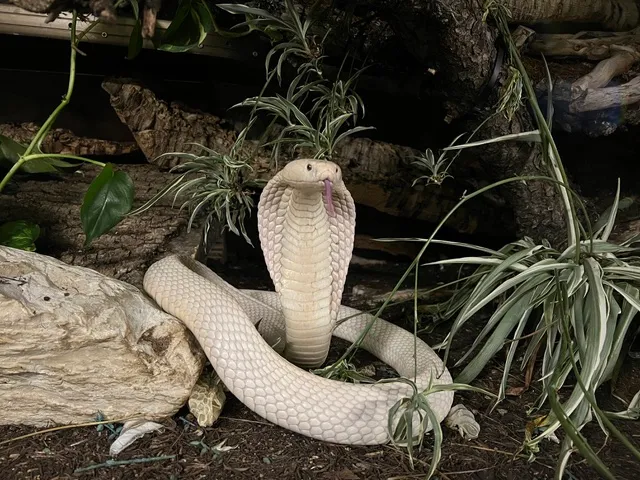
A very lively, easily agitated cobra from South and Southeast Asia with the typical monocle mark on the back of the neck and remarkably varied colouring. Its venom is life-threatening: keep it only with a permit, proven expertise, a secured venomous-snake enclosure and an emergency plan.
 Roger AeberhardExpert article and photo · Venomous snake specialist
- Group
- Snake
- Origin
- South and Southeast Asia
Where the species comes from
- World region
- South and Southeast Asia
- Countries
- Bangladesh, Myanmar, Cambodia, north-eastern India, Bhutan, Laos, northern Malaysia, southern China (Yunnan), Thailand and Vietnam
- Habitat
- Almost any habitat, preferably near water: rice fields, embankments, overgrown gardens, banana and rubber plantations; shelter under leaves, stones and logs and in termite mounds
The app does not yet hold an origin entry for this species. The distribution given here comes from the specialist literature.
The natural habitat is the yardstick for how you furnish an enclosure. Knowing where an animal comes from is knowing why it needs heat zones, hides and a particular humidity.
Husbandry at a glance
The same details appear in the animal’s profile inside the app.
- Enclosure
- A secured venomous-snake enclosure with a safety closure, larger than the minimum dimensions: the species grows large and hunts actively. Enough hides to retreat into; ideally a moist box for egg-laying that can be reached from outside.
- Temperature
- 27 to at most 32 °C by day, 20–25 °C at night. If you know where the animals come from, adjust the values accordingly.
- Humidity
- Raise it before shedding so the skin comes off completely; keep young snakes slightly more humid.
- Lighting
- A heat spot that the animals like to lie under.
- Substrate
- Peat substitute or soil.
- Furnishings
- Enough hides plus shelves and raised spots to climb on.
- Water
- A larger water basin is readily used.
- Feeding
- Mice; after their first shed, young snakes usually eat hairless newborn mice on their own. Separate pairs for feeding, safest individually in boxes; afterwards mist them with lukewarm water, which calms them.
- Behaviour
- Very lively, easily agitated and quick to strike; rears up and threatens when it feels threatened.
- Handling
- Only with two hooks and full concentration. Guide larger animals at the front with the hook and hold them at the back by hand (tailing); learn this technique only from an experienced mentor.
- Cohabitation
- Keeping a pair long-term is possible, never several males together. Always raise young snakes separately: cobras also eat other snakes.
- Health
- Carry out checks without contact wherever possible; use a reptile vet experienced with venomous snakes.
- Seasonal cycle
- A winter rest between October and November at about 18 °C day and night, individually in larger boxes, has proved its worth. Mating often starts soon after the animals are put back together in December or January. Incubate the eggs at 28–29 °C; after 50–60 days, young of 25–30 cm hatch.
- Safety
- Life-threateningly venomous. A permit, proven expertise, an antivenom and emergency plan and local law must all be checked.
In more detail in the expert article by Roger Aeberhard: «The monocled cobra: notes from practice» (in German)
Legal position in Switzerland
Permit required
Requires a permit as a venomous snake under Art. 89 let. h of the Ordinance: it covers snakes that have a venom apparatus and can use it. Only species designated harmless by the federal office are exempt; the monocled cobra is not among them. Permit and proof of competence are required before acquisition
Training required
Proof of competence under Art. 85 para. 3 let. c of the Ordinance is required. It is a precondition for the permit and must be obtained before acquisition
Species protection applies
CITES Appendix II (Washington Convention). In Switzerland you need papers for every animal that prove its origin and lawful acquisition. They go with the animal when you pass it on (Art. 10 BGCITES). Anyone offering the animal publicly states the CITES appendix, the scientific name and whether it comes from captive breeding or the wild (Art. 7a VCITES). Switzerland has no general marking requirement. The EU lists the species in Annex B
Minimum enclosure dimensions
Annex 2, table 5 of the Animal Welfare Ordinance does not prescribe centimetres but multiples of body length. For this species, item 47 (Ground-dwelling elapids): floor area 1 × 0.5 body lengths, height 0.5 body lengths. The floor area applies to at most two animals; each further animal requires an additional 0.5 × 0.2 body lengths.
For this group, body length means the total length, from snout to tail tip. The largest animal in the enclosure is what counts. The enclosure may not be smaller even if fewer animals live in it than the table names.
| Total length | At least |
|---|---|
| 120 cm | 120 × 60 × 60 cm |
| 150 cm | 150 × 75 × 75 cm |
| 180 cm | 180 × 90 × 90 cm |
| 200 cm | 200 × 100 × 100 cm |
Animals may temporarily be kept in smaller enclosures: for quarantine, for the treatment of illness and injury, for acclimatisation, for breeding and rearing, and for winter or cold dormancy or aestivation (preliminary remark D on reptiles).
This is the legal lower limit, not a recommendation. An enclosure that meets exactly these dimensions is permitted, but not good for that reason. The details under “Husbandry at a glance” describe how the enclosure should be furnished, not how small it may be.
What the enclosure must provide
Contact the cantonal veterinary office before acquiring the animal. This is mandatory. An escape-proof enclosure with a safety closure (a bolt is sufficient), safe working procedures and, depending on the canton, further safety conditions are required. A permit is granted only if the enclosure, equipment, expertise and protection of people and animals are adequate.
Paperwork
Keep the keeping permit, proof of training, proof of origin, emergency and safety documentation and, where applicable, liability insurance and CITES papers.
These details are a guide, not legal advice. Binding information comes from the cantonal veterinary office; the text of the ordinance is what counts. More on the legal position