
SpeciesWestern green mamba
Western green mamba
Dendroaspis viridis
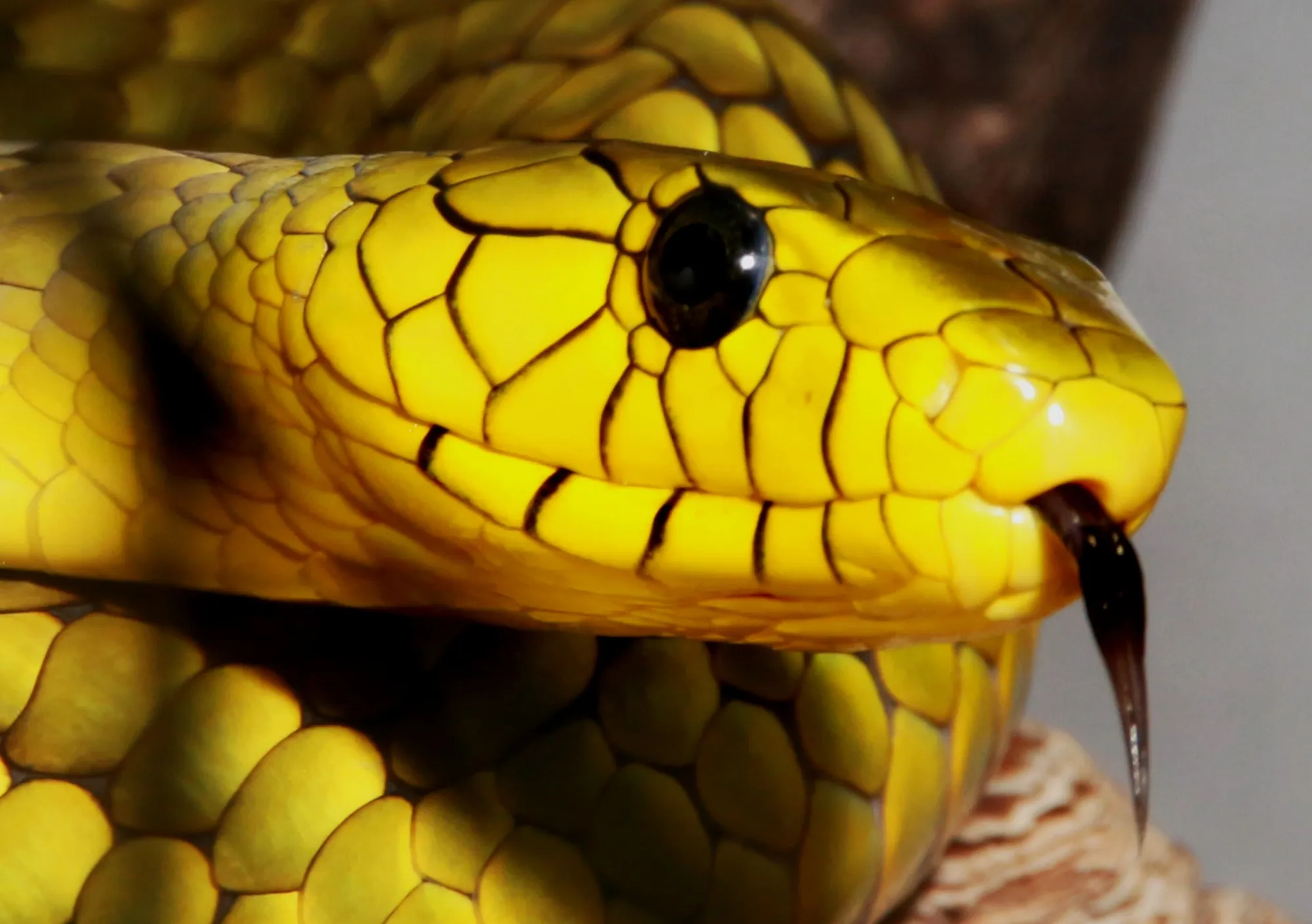
A slender elapid from the forests of West Africa that lives almost entirely in trees. Its neurotoxic venom is life-threatening: keep it only with a permit, proven expertise, a secured venomous-snake enclosure and an emergency plan.
 Roger AeberhardPhoto · Venomous snake specialist
- Group
- Snake
- Origin
- West Africa
Where the species comes from
- World region
- West Africa
- Countries
- Gambia, Senegal, Guinea, Guinea-Bissau, Sierra Leone, Liberia, Côte d’Ivoire, Ghana, Togo, Benin and Nigeria
- Habitat
- Forests and forest edges, almost exclusively in trees and shrubs
The app does not yet hold an origin entry for this species. The distribution given here comes from the specialist literature.
The natural habitat is the yardstick for how you furnish an enclosure. Knowing where an animal comes from is knowing why it needs heat zones, hides and a particular humidity.
Husbandry at a glance
The care profile for this species is still being prepared. Until then: plan climate, lighting and furnishing according to reliable specialist literature and ask experts if in doubt.
Legal position in Switzerland
Permit required
Requires a permit as a venomous snake under Art. 89 let. h of the Ordinance: it covers snakes that have a venom apparatus and can use it. Only species designated harmless by the federal office are exempt; the western green mamba is not among them. Permit and proof of competence are required before acquisition
Training required
Proof of competence under Art. 85 para. 3 let. c of the Ordinance is required. It is a precondition for the permit and must be obtained before acquisition
No CITES listing
Not listed in the CITES appendices: Import and transfer require no species-protection papers. Keep the proof of purchase nonetheless
Minimum enclosure dimensions
Annex 2, table 5 of the Animal Welfare Ordinance does not prescribe centimetres but multiples of body length. For this species, item 48 (Arboreal elapids): floor area 1 × 0.5 body lengths, height 0.7 body lengths. The floor area applies to at most two animals; each further animal requires an additional 0.5 × 0.2 body lengths.
For this group, body length means the total length, from snout to tail tip. The largest animal in the enclosure is what counts. The enclosure may not be smaller even if fewer animals live in it than the table names.
| Total length | At least |
|---|---|
| 140 cm | 140 × 70 × 98 cm |
| 160 cm | 160 × 80 × 112 cm |
| 180 cm | 180 × 90 × 126 cm |
| 210 cm | 210 × 105 × 147 cm |
Animals may temporarily be kept in smaller enclosures: for quarantine, for the treatment of illness and injury, for acclimatisation, for breeding and rearing, and for winter or cold dormancy or aestivation (preliminary remark D on reptiles).
This is the legal lower limit, not a recommendation. An enclosure that meets exactly these dimensions is permitted, but not good for that reason. The details under “Husbandry at a glance” describe how the enclosure should be furnished, not how small it may be.
What the enclosure must provide
Contact the cantonal veterinary office before acquiring the animal. This is mandatory. An escape-proof enclosure with a safety closure (a bolt is sufficient), safe working procedures and, depending on the canton, further safety conditions are required. A permit is granted only if the enclosure, equipment, expertise and protection of people and animals are adequate.
Paperwork
Keep the keeping permit, proof of training, proof of origin, emergency and safety documentation and, where applicable, liability insurance and CITES papers.
These details are a guide, not legal advice. Binding information comes from the cantonal veterinary office; the text of the ordinance is what counts. More on the legal position