
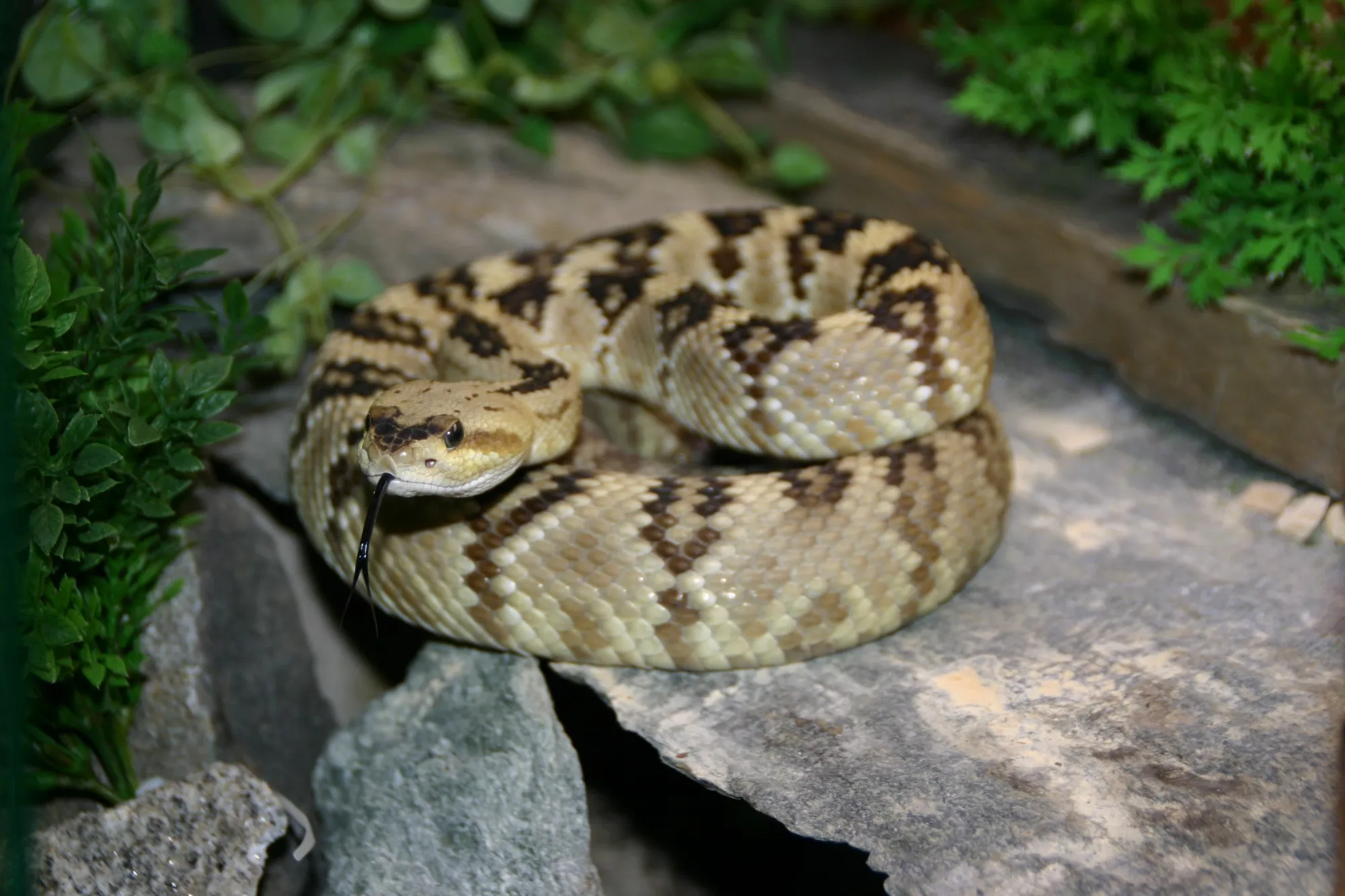
SpeciesBlack-tailed rattlesnake
Black-tailed rattlesnake
Crotalus molossus
A rattlesnake from the mountains and deserts of the south-western USA and Mexico, boldly marked or pale and washed-out depending on where it comes from. Its venom is life-threatening: keep it only with a permit, proven expertise, a secured venomous-snake enclosure and an emergency plan.
 Roger AeberhardExpert article and photos · Venomous snake specialist
- Group
- Snake
- Origin
- Southwestern United States and Mexico
Where the species comes from
- World region
- Southwestern United States and Mexico
- Countries
- Arizona, New Mexico, Texas and much of Mexico
- Habitat
- Rocky slopes, canyons and mixed pine-oak forests up to more than 3,000 m, often near streams; at low elevations barren deserts and scrubland
The app does not yet hold an origin entry for this species. The distribution given here comes from the specialist literature.
The natural habitat is the yardstick for how you furnish an enclosure. Knowing where an animal comes from is knowing why it needs heat zones, hides and a particular humidity.
Husbandry at a glance
The same details appear in the animal’s profile inside the app.
- Enclosure
- Only in a professionally secured venomous-snake enclosure with a safety closure and a written working procedure. The larger it is, the easier it is to create climate zones; the room should not be too warm, so that the temperature can drop at night.
- Temperature
- Highland animals 24–26 °C by day with a basking spot up to 28 °C; lowland animals 28–30 °C with a basking spot up to 32 °C. At night the temperature may drop to 20 °C.
- Lighting
- LED daylight and a UV spot as the basking area, wattage chosen to suit the room temperature. Lights on for 8 hours in spring, up to 12 hours in summer and 8 hours again in autumn.
- Substrate
- Soil, forest soil or a mix of soil and sand.
- Furnishings
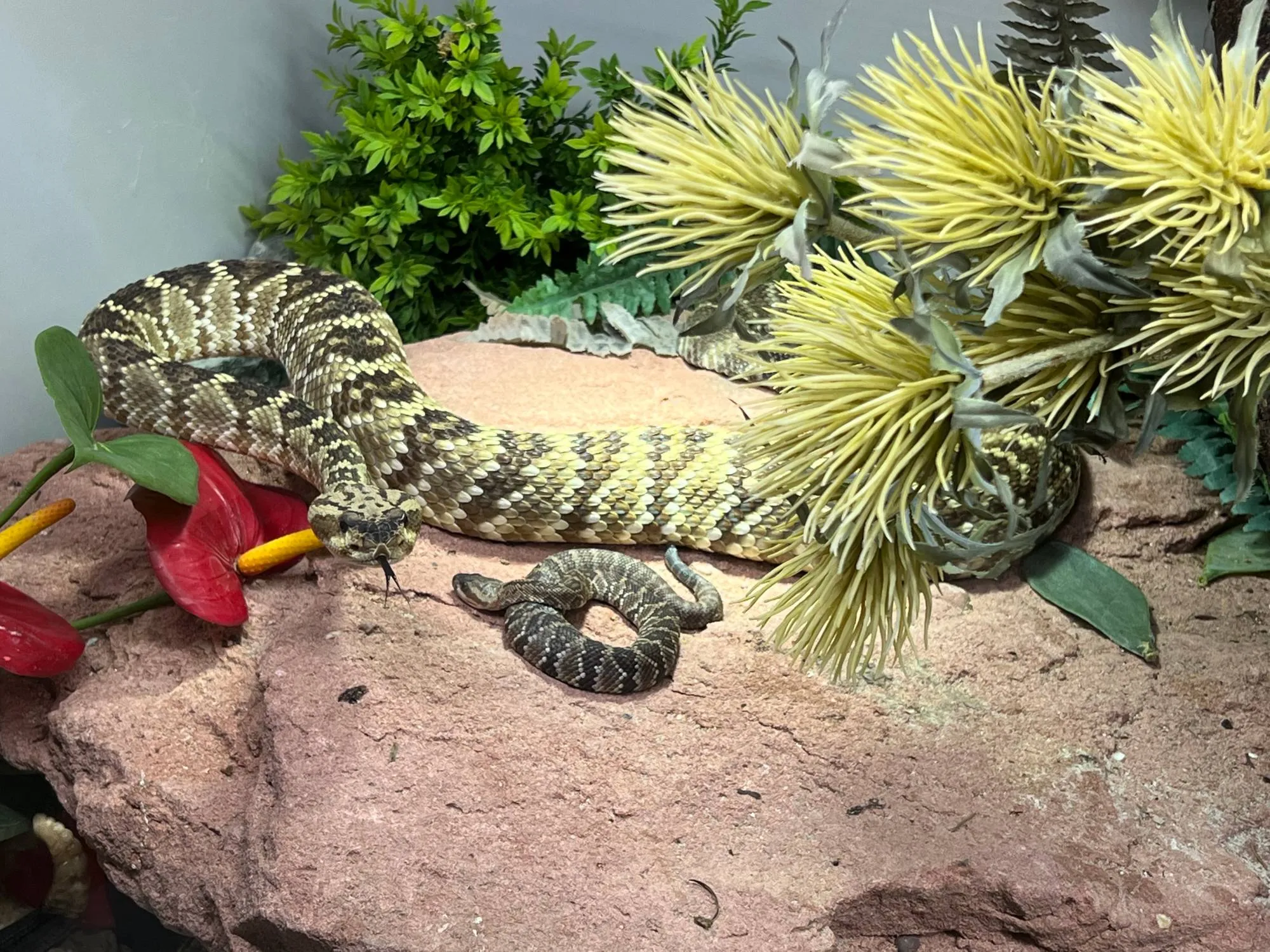
- Stones imitating rocks and ledges, a raised wooden shelf, cork bark as hides and agaves or succulents as visual cover.
- Water
- A water basin is a must.
- Feeding
- Thawed mice warmed to 39 °C: pit vipers do not recognise food that is too cool as prey. After their first shed, young snakes eat newborn mice. Art. 4 para. 3 of the Ordinance allows live prey only in exceptional cases.
- Behaviour
- Crepuscular and nocturnal in the lowlands, active by day in the mountains. Considered calm among rattlesnakes, but its venom remains life-threatening.
- Handling
- No handling by hand. It can be lifted and moved well with two hooks; it does not like having its head pinned.
- Cohabitation
- Pairs work well, several males together do not. When kept in pairs, feed in the enclosure while the animals are lying a little apart.
- Health
- Carry out checks without contact wherever possible; use a reptile vet experienced with venomous snakes.
- Seasonal cycle
- Highland animals need a brumation, ideally at a steady 10–14 °C; lowland animals a night-time drop to 10–12 °C with about 15 °C by day. In captivity the mating season is often in spring, in the wild mostly in autumn before hibernation; in July or August usually 4 to 8 young are born live.
- Safety
- Life-threateningly venomous. A permit, proven expertise, an antivenom and emergency plan and local law must all be checked.
In more detail in the expert article by Roger Aeberhard: «The black-tailed rattlesnake: notes from practice» (in German)
Legal position in Switzerland
Permit required
Requires a permit as a venomous snake under Art. 89 let. h of the Ordinance: it covers snakes that have a venom apparatus and can use it. Only species designated harmless by the federal office are exempt; the black-tailed rattlesnake is not among them. Permit and proof of competence are required before acquisition
Training required
Proof of competence under Art. 85 para. 3 let. c of the Ordinance is required. It is a precondition for the permit and must be obtained before acquisition
No CITES listing
Not listed in the CITES appendices: Import and transfer require no species-protection papers. Keep the proof of purchase nonetheless
Minimum enclosure dimensions
Annex 2, table 5 of the Animal Welfare Ordinance does not prescribe centimetres but multiples of body length. For this species, item 55 (Ground-dwelling vipers and pit vipers): floor area 1 × 0.5 body lengths, height 0.5 body lengths. The floor area applies to at most two animals; each further animal requires an additional 0.5 × 0.2 body lengths.
For this group, body length means the total length, from snout to tail tip. The largest animal in the enclosure is what counts. The enclosure may not be smaller even if fewer animals live in it than the table names.
| Total length | At least |
|---|---|
| 90 cm | 90 × 45 × 45 cm |
| 110 cm | 110 × 55 × 55 cm |
| 130 cm | 130 × 65 × 65 cm |
| 150 cm | 150 × 75 × 75 cm |
Sidewinding species are excepted; item 56 applies to them, with 1.5 × 0.5 body lengths.
Animals may temporarily be kept in smaller enclosures: for quarantine, for the treatment of illness and injury, for acclimatisation, for breeding and rearing, and for winter or cold dormancy or aestivation (preliminary remark D on reptiles).
This is the legal lower limit, not a recommendation. An enclosure that meets exactly these dimensions is permitted, but not good for that reason. The details under “Husbandry at a glance” describe how the enclosure should be furnished, not how small it may be.
What the enclosure must provide
Contact the cantonal veterinary office before acquiring the animal. This is mandatory. An escape-proof enclosure with a safety closure (a bolt is sufficient), safe working procedures and, depending on the canton, further safety conditions are required. A permit is granted only if the enclosure, equipment, expertise and protection of people and animals are adequate.
Paperwork
Keep the keeping permit, proof of training, proof of origin, emergency and safety documentation and, where applicable, liability insurance and CITES papers.
These details are a guide, not legal advice. Binding information comes from the cantonal veterinary office; the text of the ordinance is what counts. More on the legal position